She was born today - June 23, 1940Wilma Rudolph
From Wikipedia, the free encyclopedia
Wilma Glodean Rudolph (June 23, 1940 – November 12, 1994) was an
American athlete. Rudolph was considered the fastest woman in the world in the 1960s and competed in two
Olympic Games, in 1956 and in 1960.
In the
1960 Summer Olympics in
Rome Rudolph became the first American woman to win three
gold medals in track and field during a single Olympic Games.
[1] A track and field champion, she elevated women's track to a major presence in the United States. She is also regarded as a civil rights and women's rights pioneer. Along with other 1960 Olympic athletes such as
Cassius Clay, who later became
Muhammad Ali, Rudolph became an international star due to the first international television coverage of the Olympics that year.
[2]The powerful
sprinter emerged from the 1960 Rome Olympics as "The Tornado," the fastest woman on earth.
[3] The
Italians nicknamed her
La Gazzella Negra ("The Black Gazelle"); to the
French she was
La Perle Noire ("The Black Pearl").
[4][5] She is one of the most famous
Tennessee State University Tigerbelles, the name of the TSU women's track and field program.
Biography
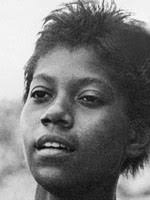
Wilma Rudolph was born prematurely at 4.5 lbs., the 20th of 22 siblings; her father Ed was a railway porter and her mother Blanche a maid.
[6] Rudolph contracted
infantile paralysis (caused by the polio virus) at age four. She recovered, but wore a brace on her left leg and foot (which had become twisted as a result) until she was nine. She was required to wear an orthopaedic shoe for support of her foot for another two years. Her family travelled regularly from segregated
Clarksville, Tennessee, to
Fisk University's black medical college hospital in
Nashville, Tennessee for treatments for her twisted leg. In addition, by the time she was twelve years old she had also survived bouts of
scarlet fever,
whooping cough,
chickenpox, and
measles.
[6] 
Wilma Rudolph at the finish line during 50 yard dash at track meet in Madison Square Garden, 1961
In 1952, 12-year-old Rudolph finally achieved her dream of shedding her handicap and becoming like other children. Her older sister was on a
basketball team, and Wilma vowed to follow in her footsteps. While in
high school, Rudolph was on the basketball team when she was spotted by
Tennessee State track and field coach
Ed Temple. Being discovered by Temple was a major break for a young athlete. The day he saw the tenth grader for the first time, he knew he had found a natural athlete. Rudolph had already gained some track experience on Burt High School's track team two years before, mostly as a way to keep busy between basketball seasons.
[7]While attending Burt High School, Rudolph became a basketball star setting state records for scoring and leading her team to the state championship. She also joined Temple's summer program at Tennessee State and trained regularly and raced with his Tigerbelles for two years.
[6] By the time she was 16, she earned a berth on the U.S. Olympic track and field team and came home from the
1956 Melbourne Games with an Olympic
bronze medal in the
4 x 100 m relay to show her high school classmates.
[6]At the
1960 Summer Olympics in Rome she won three Olympic titles: the
100 m,
200 m and the 4 x 100 m relay. As the temperature climbed toward 110 degrees, 80,000 spectators jammed the
Stadio Olimpico. Rudolph ran the 100-meter dash in an impressive 11 seconds flat. However the time was not credited as a
world record, because it was wind-aided. She also won the 200-meter dash in 23.2 seconds, a new Olympic record. After these wins, she was being hailed throughout the world as "the fastest woman in history". Finally, on September 11, 1960, she combined with Tennessee State teammates
Martha Hudson,
Lucinda Williams and
Barbara Jones to win the 400-meter relay in 44.5 seconds, setting a world record.
[6] Rudolph had a special, personal reason to hope for victory—to pay tribute to
Jesse Owens, the celebrated American athlete who had been her inspiration, also the star of the
1936 Summer Olympics, held in
Berlin, Germany.
[8]Following post-games European tour by the American team Rudolph returned home to Clarksville. At her wishes, her homecoming parade and banquet were the first fully integrated municipal events in the city's history.
[6] 
Rudolph retired from track competition in 1962 at age 22 after winning two races at a U.S.–
Soviet meet.
In 1963, Wilma married her high school sweetheart, Robert Eldridge, with whom she had four children: Yolanda (1958), Djuanna (1964), Robert Jr. (1965), and Xurry (1971). They later divorced.
Awards and honors
Rudolph was United Press Athlete of the Year 1960 and
Associated Press Woman Athlete of the Year for 1960 and 1961. Also in 1961, the year of her father's death, Rudolph won the
James E. Sullivan Award, an award for the top amateur athlete in the United States, and visited President
John F. Kennedy.
[9]She was voted into the National Black Sports and Entertainment Hall of Fame in 1973
[10] and the National Track and Field Hall of Fame in 1974.
[11] 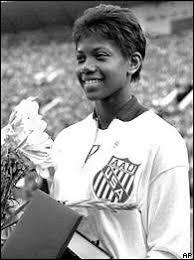
She was inducted into the
U.S. Olympic Hall of Fame in 1983, honored with the National Sports Award in 1993, and inducted into the
National Women's Hall of Fame in 1994.
[12]In 1994, the portion of U. S. Route 79 in Clarksville, Tennessee between the Interstate 24 exit 4 in Clarksville to the Red River (Lynnwood-Tarpley) bridge near the Kraft Street intersection was renamed to honor Wilma Rudolph.
Career and family
In 1963, Rudolph was granted a full
scholarship to
Tennessee State University where she received her
bachelor's degree in elementary education. After her athletic career, Rudolph worked as a teacher at Cobb Elementary School, coaching track at Burt High School, and became a sports commentator on national television.
She married her high school sweetheart Robert Eldridge in 1963, and had four children: Yolanda (b. 1958), Djuanna (b. 1964), Robert Jr. (b. 1965) and Xurry (b. 1971). Rudolph and Eldridge later divorced.
Death
In July 1994, shortly after her mother’s death, Rudolph was diagnosed with
brain cancer. On November 12, 1994, at age 54, she died of cancer in her home in Nashville. At the time of her death, she had four children, eight grandchildren, and many nieces and nephews.
[13] Thousands of mourners filled Tennessee State University's Kean Hall on November 17, 1994, for the memorial service in her honor. Others attended the funeral at Clarksville's First Baptist Church. Across Tennessee, the state flag flew at half-mast.
Nine months after Rudolph's death, Tennessee State University, on August 11, 1995, dedicated its new six-story dormitory the "Wilma G. Rudolph Residence Center." A black
marble marker was placed on her grave in Clarksville's Foster Memorial Garden Cemetery by the Wilma Rudolph Memorial Commission on November 21, 1995. In 1997, Governor
Don Sundquist proclaimed that June 23 be known as "Wilma Rudolph Day" in Tennessee.
[14] 
Legacy
In 1994,
Wilma Rudolph Boulevard was the name given to the portion of
U.S. Route 79 in Clarksville, Tennessee.
The Woman's Sports Foundation Wilma Rudolph Courage Award is presented to a female athlete who exhibits extraordinary courage in her athletic performance, demonstrates the ability to overcome adversity, makes significant contributions to sports and serves as an inspiration and role model to those who face challenges, overcomes them and strives for success at all levels. This award was first given in 1996 to
Jackie Joyner-Kersee.
[15]A life-size bronze statue of Rudolph stands at the southern end of the Cumberland River Walk at the base of the Pedestrian Overpass, College Street and Riverside Drive, in Clarksville.
[16]In 2000
Sports Illustrated magazine ranked Rudolph as number one in its listing of the top fifty greatest sports figures in twentieth-century Tennessee.
[17]Following the withdrawal of U.S. troops from Berlin in 1994, Berlin American High School (BAHS) was turned over to the people of Berlin and became the "Gesamtschule Am Hegewinkel." The school was renamed the "Wilma Rudolph Oberschule" in her honor in the summer 2000.
[18]On July 14, 2004, the
United States Postal Service issued a 23 cent
Distinguished Americans series postage stamp in recognition of her accomplishments.
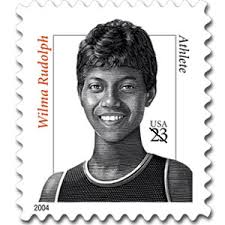
In 1977 a made-for-TV
docudrama titled
Wilma (also known as
The Story of Wilma Rudolph) was produced by
Bud Greenspan; it starred
Shirley Jo Finney,
Cicely Tyson,
Jason Bernard and
Denzel Washington in one of his first roles.

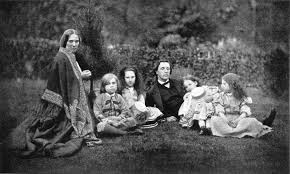
 He fulfilled the small girl's request, and through a series of coincidences, the story fell into the hands of the novelist Henry Kingsley, who urged Carroll to publish it. The book Alice's Adventures in Wonderland was released in 1865. It gained steady popularity, and as a result, Carroll wrote the sequel, Through the Looking-Glass and What Alice Found There (1871). By the time of his death, Alice had become the most popular children's book in England, and by 1932 it was one of the most popular in the world.


